
NVQF Pakistan: How NVQF 2025 Has Evolved
How NAVTTC’s 2025 update reshapes levels, credits, grading, and licensing across Pakistan’s TVET system.
Why NVQF Pakistan Needed a 2025 Update
National Vocational Qualification Framework – NVQF Pakistan has changed dramatically since it first launched in 2015. If you’re trying to make sense of the framework today, it might look unfamiliar. It’s almost unrecognizable next to the slim operational manuals NAVTTC published back in 2017. Back then, NVQF Pakistan was little more than a basic certificate system for technical training. Today, however, it has grown into a credit-based, digitally tracked framework that reaches from Grade 6 classrooms all the way to postgraduate Technology degrees.
So what actually changed, and why does it matter to you? Are you a student choosing a training pathway? A trainer applying for a license? Or an employer trying to read an NVQ certificate correctly? Either way, the differences between the 2017, 2024, and 2025 versions are worth understanding. Below, I break each one down in plain terms.
NVQF Pakistan at a Glance: 2017 vs 2024 vs 2025
- Document structure: 2017 = a main policy paper plus three separate manuals → 2024 = one consolidated “NVQF Regulations” → 2025 = a single, polished “NVQF 2025, Version 3” document.
- Levels: 2017 = 8 levels, only 1–4 active → 2024/2025 = 8 levels plus a Foundation stage, all mapped to school grades and credits.
- Credit system: Non-existent in 2017 → introduced in 2024 as Credit Accumulation and Transfer System (CATS) → refined and recalibrated in 2025.
- Assessment: Simple Competent / Not-yet-Competent in 2017 → a weighted grading system from 2024 onward, now paired with an official grading-to-percentage scale in 2025.
- Trainer & assessor rules: Loosely defined in 2017 → formal licensing tiers in 2024 → age- and qualification-tiered licensing in 2025.
- Digital records: limited digital-based registry in 2017 → the NVQS digital platform from 2024 onward.5
How NVQF Pakistan Moved From Scattered Manuals to One Framework
By 2024, that had changed completely. NAVTTC consolidated everything into one formal document: the NVQF Regulations, 2024. Then came the 2025 edition, officially titled National Vocational Qualifications Framework 2025, Version 3. It refined that same structure even further, adding clearer chapters, a proper table of figures, and a far more polished, public-facing design. In short, NVQF Pakistan grew from a working manual into a genuine national policy instrument.
A Taller Ladder: New Levels, a Foundation Stage, and Credit-Based Entry
The 2017 framework had eight levels on paper. However, only Levels 1 to 4 were actually operational at the time. Everything above that — diplomas and Technology degree Programs — existed mostly as domains under Provincial TVETAs for 3 years DAE programs and B tech programs under HEC.
The 2024 and 2025 versions changed that. First, they added a Foundation level below Level 1. Then, they tied every level to a formal entry grade and credit table. For example, a Foundation qualification is now open to a Grade 5 student, while Level 1 begins at Grade 6. This continues up through Level 8, which corresponds to a PhD in Engineering Technology. Each level also specifies minimum credits, the awarding body, and the expected occupational outcome — worker, skilled, highly-skilled, supervisor, or manager.
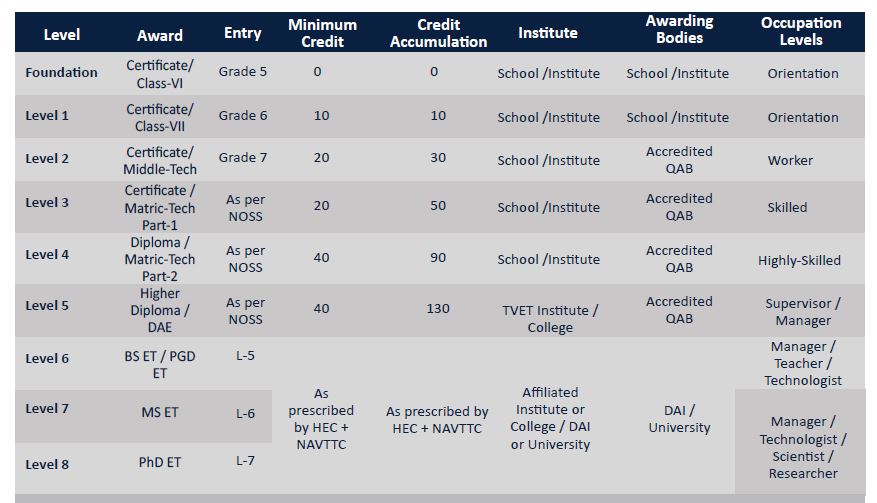
In addition, the 2025 version introduces a “Direct Entry into a Level” clause. This lets institutes enroll a learner straight into a higher level, such as Level 4, as long as they meet the prerequisites. As a result, students no longer have to move through every level in strict sequence. That flexibility simply didn’t exist in 2017 or even in 2024.
NVQF Pakistan's New Credit Accumulation and Transfer System (CATS)
The 2025 version builds on this further with a dedicated credit conversion mechanism. It also recalibrates credit values at each level; for instance, Level 4 now requires a minimum of 40 credits, up from 30 in 2024. As a result, a learner’s training is no longer a closed box. Credits earned in one program can now count toward another. That’s similar in spirit to how the European Qualifications Framework allows mobility between national systems across Europe.
Tech-Stream: How NVQF Pakistan Blends TVET With Mainstream Schooling
If there’s one idea that defines the 2025 framework, it’s this: vocational training is no longer a track separate from regular schooling. The 2024 Regulations first introduced Middle-Tech, Matric-Tech, and Inter-Tech. These are dual-recognition pathways where a student can earn a Matriculation certificate and an NVQ Diploma at the same time.
The 2025 version names this the “Tech-Stream” and gives it a dedicated diagram showing how learners can move between general education and TVET at multiple points. This includes an Accelerated Learning Programme (ALP) route for out-of-school children. It’s also explicitly tied to the National Education Policy and the National Skills Strategy 2024–29. As a result, schools are now expected to offer at least one NVQF-recognized subject. For the bigger policy picture behind this shift, our earlier post on Pakistan’s National Skills Strategy 2025–29 recommendations covers the reasoning in more depth.
Grading Replaces the Old Pass/Fail System
The 2024 Regulations introduced a weighted grading system instead: Knowledge Test (40%), Practical Observation (50%), and Portfolio Assessment (10%). The 2025 framework keeps this same structure, but adds one important upgrade. NAVTTC must now publish an official grading-to-percentage conversion scale. That matters because it lets an NVQ result be referenced credibly for university admission or job applications, right alongside conventional grades. Notably, the terminology has shifted too. The 2025 document consistently uses the word “Learner” rather than “candidate” — a small but telling sign of a more learner-centered approach.
Recognition of Prior Learning Gets a Clear Roadmap
By 2024, and carried through into 2025, RPL became a properly staged process instead. First comes an Initial Interview, followed by Evidence Gathering, then Assessment of RPL Evidence, Gap Training where needed, and finally the Qualification Award. Each authorized assessment centre and QAB now has clearly defined responsibilities at every step. As a result, someone who has spent years learning a trade informally — for example, through an Ustad-Shagird apprenticeship — can convert that real experience more easily. The outcome is a recognized, portable qualification.
How NVQF Pakistan Raises the Bar for Trainers and Assessors
The 2024 Regulations added a parallel licensing track for trainers: Certified, Master, and Chief Master. Even so, eligibility criteria were still mostly identical across every tier. The 2025 version fixes that by introducing rising age and qualification thresholds instead. A Certified Trainer must now be at least 25, with a Matric-level qualification. A Master Trainer must be at least 28, with Intermediate. A Chief Master Trainer must be at least 31, with a full Graduate degree. License renewal is also now tied to demonstrated ongoing activity, not just the passage of time. This whole area has even been renamed the “Licensing Regime for Trainers and Assessors”. It now gets a full chapter of its own — a clear signal of how central trainer quality has become to the system.
Better Governance and Digital Record-Keeping
The old NVQF Management Committee (NMC) from 2017 became the NVQF Implementation Committee (NIC) by 2024, and that name has stuck for 2025. It’s a subtle shift from “managing” the framework to actively “implementing” it. Meanwhile, the 2025 version adds something entirely new: a Complaint Redressal Committee. It’s chaired by NAVTTC’s Director General of Accreditation & Certification and handles disputes over qualification equivalence.
In parallel, the paper-based “NVQ Registry” of 2017 has become the NVQS (National Vocational Qualifications System) — a full digital platform. By 2025, records of achievement are auto-generated through NVQS, and every licensed trainer and assessor receives a unique digital ID. This kind of digital infrastructure matters more than it might seem. After all, traceable and verifiable credentials are exactly what shows up again and again when you look at what’s actually driving future job markets.
What NVQF Pakistan Means for the Workforce
The author is a retired Air Commodore and Director at the National University of Technology (NUTECH) – read more about author at naveedblog.com
Sir wonderful job done by you. Most ppl in TVET even don’t know these major changes/value added features in NVQF.
Thanks for the comments. The purpose was to make people aware of the latest changes so that, NVQF is implemented in the true letter and spirit.